On The Measure Podcast, Dr. Dwayne Proctor of Missouri Foundation for Health talks about the complexity and necessity of standing up for health equity—working with communities to remove barriers and shape innovations across the state.
Dr. Dwayne Proctor is president and CEO of Missouri Foundation for Health. The foundation works to improve health through collaboration, convening, knowledge sharing, and strategic investment, never losing sight of the equity lens that shapes all its work. During his 20-plus years in philanthropy, Dr. Proctor has always worked to ensure that American communities are healthy and thriving. He serves on multiple boards, including the National Committee for Responsive Philanthropy (NCRP) and NAACP, and advises organizations nationally.
BACK TO EPISODES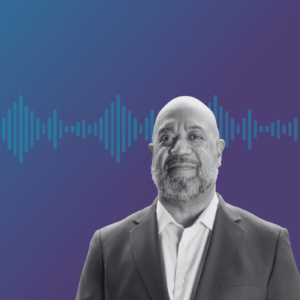
Dwayne Proctor:
But I can’t just say that it’s up to young people to do this. I think if we’re going to rely on our young people, then we need to think about, how do we have more intergenerational approaches being played out? So that young folks can share what they know with older folks, who can share what they know. So that the younger folks cannot have to start from square one in order to make a difference and a change.
Leon T. Andrews, Jr.:
Welcome to The Measure. I am your host, Leon Andrews, president and CEO of Equal Measure. At Equal Measure, we partner with foundations, nonprofits, and public institutions to advance social justice through learning, measurement, evaluation, and strategy. On the podcast, we talk with leaders and practitioners about centering racial equity and transforming systems.
Today, I am honored to speak with Dr. Dwayne Proctor. Dwayne is the president and CEO of Missouri Foundation for Health. He has more than 20 years of experience in philanthropy, including his time at the Robert Wood Johnson Foundation. And I’m also proud to be able to call him a good friend. Welcome, Dwayne.
Dwayne Proctor:
Hey, thank you, Leon. I appreciate being here.
Leon T. Andrews, Jr.:
And I want to start there for our audience to really get a sense of you and who you are. We tend to ask our guests about their background because we very much believe that place and context matters as we think about who people are, how you show up, and how it shapes who you are.
So, I’d love for you to share with our audience how you think about place, how you think about context in your journey, and how it shaped how you would say who you are today.
Dwayne Proctor:
I’m from Washington, DC. I’m a proud Washingtonian. I’m bred in the DMV. My family comes from Washington, DC, so we’ve been there for a few generations. And it just made for a great way to grow up because I was surrounded. I couldn’t get away with anything. I mean, there are people everywhere. I bump into … I still do this. When I’m in DC, I bump into cousins and I’m like, “Oh, hey.” And that’s a part of the thrill of coming home when I do do so.
My grandfather in DC, I forgot to mention, he was a Pullman Porter. And it’s really important to point this out because Pullman Porters were … they wrote the blueprint for the Civil Rights movement. Even before everything kicked off, gaining rights for themselves and their work. So, social justice, standing up for rights, knowing our politics. I always say that DC is full of get-up, stand-up people.
Leon T. Andrews, Jr.:
Yeah. I love that story, Dwayne. But you also have a fascinating storyline when I first met you many years ago about your journey with Ray Charles. So, I can’t let the audience not know about how you talk about how that was also part of your narrative. So, talk about the time you were working with and hanging out with Ray Charles.
Dwayne Proctor:
So, it still starts in DC. So, I think when I was 14, I decided I wanted to be a disc jockey. And, of course, I decided I wanted to be the world’s greatest disc jockey. And, so, I got involved in radio and radio broadcasting.
I went to Virginia Tech to study communications. And two years later I went to my advisor and I asked my advisor, I said, “I think I’m done. I think I’m ready to graduate. I’ve taken all your classes, and I need to get back to DC and get back in the market.” And they explained to me that I needed to have a minor. And, so, when I came back for my third year, it was after my mom had married and my Pell Grants were gone.
So, I was out of school. I was a college dropout for reasons of finances, not academics. I had a job at a country and western radio station. I was a DJ in a nightclub. I cooked at a restaurant. All three jobs, all to make money to try to go back to school.
I happened to be cleaning records at the disco one night, or one afternoon, and Ray Charles’s band members walked in, four of them. And we hung out. And then, eventually, the road manager said, he invited me to go on the road with them to be the sound mixer and the announcer for the concerts.
And we went around the world a couple of times. I was on two world tours. And Ray Charles one night told me, he says, “You know what? You really should go back to school.” And, so, when Ray Charles gives you advice, you take it.
Eventually I applied at school at University of Connecticut, and every year I would see Ray Charles in a band because the tours are cyclical and they always came to where I was. So, I was always able to go back and get a dose of wisdom. And I was happy that I did get a chance to share with him that I got my PhD before he died. And he and I had a long talk about that. And it was a beautiful moment. It was like a full-circle moment. And I always say that Ray Charles was the uncle that my father never knew I had.
Yeah. No, thanks for asking. It’s a great part of my background.
Leon T. Andrews, Jr.:
No, I thank you for sharing that, Dwayne. And I love that part of your story because even as I got to know you, you were at the Robert Wood Johnson Foundation. I was just starting at the National League of Cities and RWJF had just made this huge investment in reversing, was it combating or reversing childhood obesity by 2016, I think it was, and investing a half a billion dollars.
And four years ago, you left RWJF to join the Missouri Foundation for Health and to become their president and CEO. And, so, went from this major, massive national initiative to then be very targeted regionally.
Dwayne Proctor:
It’s been good, but it was quite a leap, I’m going to say, at least for me. I sat at the feet of Angela Glover Blackwell at PolicyLink and others who helped me understand the value of equity.
Equality is a great American ideal. It’s a value that we hold dear. Yet it had not been serving most of the people in the same way, and that’s where equity came in. And, so, even as we are working on childhood obesity prevention, I was learning about equity.
And, so, then coming to Missouri Foundation for Health and being able to say to their board, “I think we can achieve health equity here in 10 years.” And I heard some gasp. I heard a couple of giggles. And they’re, like, “What are you talking about?” I said, “Well, health equity is not health equality.” I mean, we want to make certain that Missourians have a fair and just opportunity to be healthy.
And that means making certain to address the barriers that may … systemic barriers, like discrimination, whether it is racial discrimination or discrimination against people with disabilities or discrimination against poor people. We need to understand that better and remove those barriers so the systems work better for everyone.
So, I was able to take that knowledge from RWJF and bring it in and make that bold and audacious statement. And I still believe it’s true. It may take a little bit more than 10 years. But I still believe it’s true because what I really meant was, how do we engage with communities in a way that we can learn from community wisdom?
If we went into a community, and this happened, and we said, we want to address the abysmal maternal and child health outcomes in Missouri, then we have to do so with communities. And as we went into some of the hardest hit communities, because that’s the other thing I learned during childhood obesity, is you have to work where the struggle is the greatest.
You have to work where the challenge is the greatest, because if you can make a difference in those areas, you can make a difference everywhere. And in the case of working on issues of Black women and babies, 30% of the Black babies who were not surviving their first year of life in Missouri, 30% were in St. Louis, in this area we call the Bootheel.
And the Bootheel is a southeast corner. It’s a little peninsula, so to speak. It’s surrounded by Tennessee, Kentucky, and Arkansas. And, so, it’s a very poor area and an area where they’re still dealing with a lot of different social traumas. And my staff told me that when they first went in there and said, “We want to work on infant and child mortality work.” The community said, “That’s great, but it has to start with housing. And making certain that we have adequate housing, affordable, adequate housing, that we can bring our babies home to an environment that was safe for them to be raised in.”
And, so, we followed the lead of communities and started working on housing issues. And then that helped build trust between our work and the communities. And we just let the community lead us along. And, right now, anecdotally speaking, many of those babies in the area are doing much better than statistics would allow for their survival. They’re living past the first year of their lives.
There’s much more work to be done, of course, but that’s the equity approach. And we now know that some of the things that we learned working in St. Louis and working on the Bootheel in that area, we can use those approaches to work with other communities. Doesn’t mean we can take what we learned in Bootheel and put it in Springfield or Joplin or Columbia. No, we can take the approaches of how we worked with communities, what lessons we learned in that way, in order to make the changes that we needed to see.
Identifying leaders is one aspect of achieving health equity in a 10-year period of time. The other is identifying innovations. And homegrown innovations, innovations that are suited for these communities that are here.
Leon T. Andrews, Jr.:
I love that, Dwayne. But are there some wins or examples of where you’re seeing some of the innovation or seeing some of the progress?
Dwayne Proctor:
Yeah, the wins are, they’re oddly obscured in ways, but we do have big wins. When I started in philanthropy, we were just getting used to the idea that foundations that create something, used to be that states would pick it up. States would pick it up and then that’s how things would roll out.
In the early 2000s, states weren’t doing that anymore. And foundations then shifted towards, well, we need to do systems changes. And we need to do systems changes, which really means you need to change policies and practices in order for them to work better and work better for everyone. And, so, that was a great era to be in philanthropy. We’re still in that era, but I’m in this very interesting state of Missouri.
And I say “interesting” with all due respect. It’s complex. It’s challenging. I’m an outsider, so I come into everything with fresh eyes, but the wins that are obscured. So, when I arrived, and this is the work of advocates and others before I was even here, have been working and pushing to get Medicaid expansion as a part of the Missouri landscape.
There was a referendum held, and the referendum was to have Medicaid expansion attached to the Missouri Constitution. The referendum passed and passed by a lot of votes. And I think 30% of the votes came from the rural communities, and all other supportive votes came from Kansas City and St. Louis areas. And I’m generalizing, but those are the areas that have more of Black and Brown populations than you might see scattered across the rural areas here in Missouri.
And the legislators were not interested in supporting the will of the people in that way, and they had their reasons for it. The governor also had his reasons for not being interested in supporting it. And, so, our foundation, along with other foundations here in Missouri, we provided dollars so that plaintiffs who were going to be unduly affected by their inactions could take this to court.
And they did. They took it to court, and the courts agreed. The court said that this was a constitutional issue, and so they were not supportive of the suit moving forward as it did. But being a constitutional issue, it went to the Missouri Supreme Court. And Missouri Supreme Court ruled in favor of the people. And 350,000 Missourians were eligible to sign up for Medicaid after that happened. And 350,000 Missourians did sign up for Medicaid. So, that was a win.
But after the public health emergency ended with COVID-19, there became some unrolling, unwinding of procedural unwindings, of people losing their Medicaid. So, that’s what I mean by the wins get obscured. And you get a win and then it goes back.
And, so, it’s a lot of ping-ponging back and forth. But, again, when we fail, we learn, right? We learn and we focus on those strong relationships and the collaborations that it took to get there.
Leon T. Andrews, Jr.:
Well, yeah, it’s real, and we are living in interesting times for sure. And you being, as you said, in an interesting state, in Missouri, these contentious climate, the political climate is what you’re … I know you’re navigating. And with the damaging effects, as you’re talking about the funding cuts. But you have still remained committed to health equity.
Dwayne Proctor:
When the first announcements came out about federal cuts to nonprofit organizations here, Missouri, last time I checked, we have 40,000 nonprofit organizations in the state, and 19,000 are right here in St. Louis. It was so destabilizing for the nonprofit networks. Many folks had to let people go. And I’m talking about laying off 65% of their staffs.
A lot of nonprofits are looking to, well, we work in the same areas, we work in the same zip codes. Can we combine and become one organization? But you need resources to do that as well. A lot of folks are scrubbing their websites and getting off words that were not offensive 10 months ago that are offensive today, like equity. And, so, it makes it very, very hard out there.
Our foundation does not take federal money or state money, unlike many foundations. So, we have an opportunity to live up to our ideals. MFH, we talk about equity as one of our core values. We talk about trust, humility, integrity, and commitment. All is our core values. Our integrity isn’t standing up for health equity. It’s what we’re about. It’s who we are.
If we were to change without being asked, if we’re going to bow to power that has not been directed towards us, then we’re not living up to a lot of those core values. If we say we’re committed to the communities that we serve, we’re committed to the communities we serve. There’s no amount of whitewashing that is going to make us be different than who we are, especially if no one’s asked us to.
Leon T. Andrews, Jr.:
I’ve enjoyed this conversation, and I hope our audience has as well. And you reflected, as we’ve been talking, about all that you’ve lived through. All the movements that have come through DC and the fights that you’ve been fighting. And then the wins, and then the step-backs, and the continuing to fight.
And, so, I’d love for the audience to hear from you. It is a question I ask all of my guests: In the midst of doing the good work and making good trouble, what continues to give you hope?
Dwayne Proctor:
I believe in the young people, and they give me a lot of hope because they will be the innovators of the future. They are the ones who do not necessarily have the baggage of living through a community that went through a riot after assassination of a great leader.
Many of them will come at these at different perspectives. But I can’t just say that it’s up to young people to do this. I think if we’re going to rely on our young people, then we need to think about how do we have more intergenerational approaches being played out? So that young folks can share what they know with older folks, who can share what they know. So that the younger folks can not have to start from square one in order to make a difference and a change.
Because we have a blueprint for the times we’re in. We didn’t have this. The blueprint we talked about, it was written by the Pullman Porters. It was written during the Civil Rights Movement. We can look to Mandela and the Anti-Apartheid Movement. We have blueprints for what it takes to maintain where we are and actually to move forward in ways that we should move forward with dignity and integrity. That’s where my hope is.
Leon T. Andrews, Jr.:
Oh, I love that. I really love that, Dwayne. And I really appreciate your time today. Your unwavering commitment to equity and healthy communities. Our inspiration to keep for all of us to keep pushing for the change that we’ve been talking about. So, thank you. Thank you, my friend.
Dwayne Proctor:
Good. I appreciate you, brother. I appreciate you a lot.
Leon T. Andrews, Jr.:
Thank you, my friend.
Dwayne Proctor:
Right on.
Leon T. Andrews, Jr.:
Take care. Take care.
As we close out today’s conversation with Dwayne, I’m reflecting on the courage it takes to tell the truth about systems that were never designed with everyone in mind. This work asks more than awareness. It asks for honesty, accountability, and a willingness to act, even when it’s uncomfortable.
Audre Lorde reminds us, “It’s not our differences that divide us. It is our inability to recognize, accept, and celebrate those differences.” Dwayne’s insights challenge us to move beyond rhetoric and toward practices that honor difference while building real pathways to equity.
Thank you for listening. Until next time, stay curious, stay courageous, and keep working toward the change you want to see.