Two cultural mindsets in the United States—individualism and deservingness—affect how we view support for families and children, says Jennifer Ng’andu, managing director at the Robert Wood Johnson Foundation. Her conversation with Equal Measure President and CEO Leon T. Andrews, Jr. highlights opportunities and examples to disrupt systems toward a healthier country.
Jennifer Ng’andu is managing director, strategic portfolios, at the Robert Wood Johnson Foundation. She helps lead the foundation’s grantmaking activities to advance social and environmental changes that help ensure that all children and their families have the full range of opportunities to lead healthy lives, while providing a strong and stable start for every child in the nation. Jennifer previously worked at the National Council of La Raza (now UnidosUS), where she oversaw efforts to advance the organization’s health and civil rights policy projects, and the National Immigration Law Center.
BACK TO EPISODES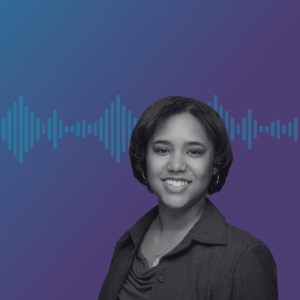
Transcript
Jennifer Ng’andu:
All of these things that so richly play a factor in how we view the world are showing up in this individualism mindset.
Leon T. Andrews, Jr.:
Welcome to The Measure. I’m your host, Leon Andrews, president and CEO of Equal Measure. At Equal Measure, we partner with foundations, nonprofits, and public institutions to advance social justice through learning, measurement, evaluation, and strategy. On the podcast, we talk with leaders and practitioners about centering racial equity and transforming systems.
Today, I am honored to speak with Jennifer Ng’andu. Jennifer is the managing director of strategic portfolios at the Robert Wood Johnson Foundation. Welcome, Jennifer.
Jennifer Ng’andu:
Leon, it’s so great to be with you.
Leon T. Andrews, Jr.:
I’m looking forward to our conversation. And I’d love to start, when we talk about this work, about how you think about place and context in your own journey and your background?
Jennifer Ng’andu:
I’d probably start by talking about the place that I grew up in: New London, Connecticut, which is this small town in southeastern Connecticut that is richly diverse. I grew up with children of all different backgrounds. I myself am a Black multiracial woman. I realized that there are communities like New London, Connecticut, that are constantly underestimated for what they can be or do, and where they are richly diverse, where they are deeply innovative, even though they experience challenges that may include poverty, that may include disenfranchisement, that may include barriers to health and well-being. And I believe that we need to do everything that we can to make sure that those communities have the resources that they need and that families have the resources that they need so that all children can grow up healthy, thrive, and make the most out of every opportunity that this country has the potential to provide.
Leon T. Andrews, Jr.:
Yeah. Thank you for painting such a beautiful picture, if you will, of multiculturalism and as you talk about your journey, your place, your context in New London.
And I think about the framing that we at Equal Measure have found to be so very useful as we think about what the work is, what the fight is. We’ve been using the, I know you’re familiar with the Racial Equity Institute’s Groundwater, their metaphor or allegory of the fish, lake, and the groundwater to talk about how we understand racism, structural racism, where the fish represent the individuals, the lake represent the systems and policies, and the groundwater represents the underlying kind of narratives that feed those systems. And I think about, I’m curious to hear how you reflect on all of the work that you just laid out there and how it kind of navigates between those different levels, as you think about the support for children and families at those different levels?
Jennifer Ng’andu:
We tend to think about the idea of what it means to address the cultural mindsets that are held in our society, and when we think about the groundwater or the narratives that run underneath, those narratives are really kind of what is expressed in the world that demonstrate those mindsets. For families and children across the country, we found that there are many cultural mindsets that interact, but there are two that we often bring forward.
The first is, sort of as a society, we are intent on a lot of rugged individualism, and there are many ways in which individualism is expressed. But for families and children, what often happens is, when you start talking about challenges or problems that they experience, there’s almost an automatic issue of whether or not they can deal with these issues on their own. So, when you talk about it being hard to get food, oftentimes people immediately go to, “Well, are they eating healthfully?” If you talk about what it means to be in a school system, there’s a question of whether or not parents are engaged or involved enough at home and not enough attention to whether or not they have three jobs. And I’m not joking. That’s the household that I grew up in. Yet my mom was still desperately trying to come and see a game when I was doing sports.
But that individualism has been almost applied even in our systems and our policy. Affordable Care Act, just using that example again. We treated every single person in a household separately. We didn’t even treat them as a unit, as a family. And, so, what that meant is that we were not really taking care of the needs of the family. We didn’t look at entire communities, we did not look at place. All of these things that so richly play a factor in how we view the world are showing up in this individualism mindset.
The second mindset is deservingness, and we talk a lot about this because families so often are placed in deserving and undeserving camps. And I see Leon, it’s this mindset that almost has a visceral reaction because we don’t want to believe that we’re making these calculations. But there’s some very real evidence that shows we often put people into deserving camps based on whether or not they can control their circumstances, their attitude. For instance, if they receive a public benefit, how they’re going to relate to it. Are they going to be grateful or thankful? Their identity—and I’m talking about uncontrollable identities—we know that race is a huge identity where people make snap judgments. Their willingness to be reciprocal, so whether or not they will give back, and our perception of their need.
Those are all things going into how we think about how families deserve. And, so, what we found is that, actually, the very ways in which our policies and our systems are designed have a lot of relationship with how we think about and process these cultural mindsets. We really want to think about what the values are in our society and uphold those, and then drive towards different systems and policy design. And, of course, we have to get at the individual and relationship level, but that all starts with conditions that actually help to support people.
Leon T. Andrews, Jr.:
Yeah, I really appreciate the way you are talking about the mindset work. As I think about the work and the conversations that I have had over the years where folks are trying to do this work, there’s a lot, you could say, that’s happening at that individual, the fish level, or even at the lake level, which is the policy and the systems, as we think about centering racial equity.
I think there is a lot of folks that are still kind of trying to understand, really, what does the groundwater work look like? And, as you described, the needing to really take on the mindset and really understanding what’s at the core of those mindsets, whether it’s at the rugged individualism or the deservedness, and what do we do with that? As we realize that that is the cultural mindset that we’re holding? And how do you disrupt it? What does it look like to disrupt it?
Jennifer Ng’andu:
Making it tangible is really important. We think there’s kind of three things that we are after.
The first is pushing towards sort of the idea of collective accountability and the idea that we are, in fact, interdependent, and pointing out all the ways in which we as a society have a stake in the health and well-being of children and families.
The second condition that we talk about is governance goals that makes children and families a priority and, really, the idea of making decisions in a different way for this country. There have been many people who have been left out of the civic engagement process, but I’ll name two that we tend to focus on. We tend to focus on parents and caregivers and children, because oftentimes their roles and how they could shape solutions and policy design is not valued. And, so, how do we create more tables where they can be a part of the process? The second is women of color, particularly those women of color who are often advancing economic justice. The thing about women of color is they’re often marginalized in more than one way, but have also been the innovators. And, so, making sure that they have the opportunity to be a part of tables that are making decisions.
The third key thing is really uplifting a new economic vision and one that is designed around health and well-being and is not about the extractive economies that we’ve seen. And, so, we’ve done really fun and powerful work with groups. For example, the Roosevelt Institute, who is thinking, what if we rewrote the tax code based on supporting the health and well-being of every child and every family in this country? What would that look like? That’s a very different conversation than we have right now about the tax system, which is, like, how you sort of make revenue flow usually to the people who already have it.
Leon T. Andrews, Jr.:
As you’re describing those three components to really getting to the grounding, the cultural mindset shift, it very much aligns with how we at Equal Measure talk about the commitment to racial equity and intersectionality—the term coined by Dr. Kimberlé Crenshaw, which really talks about, while race is one of the strongest predictors, as you were just saying, it’s not just race, it’s race and all these other compound inequities: class, gender, sexuality. And, so, the intersections of talking about pushing towards cultural accountability or setting governance goals, uplifting a new economic vision: I’m curious if you could speak to where you’re seeing success, where you’ve been able to see people able to work together at those intersections for justice?
Jennifer Ng’andu:
There’s a few examples that I would lift up. And I’m going to talk about baby bonds and I’m going to make them distinct from baby bonuses, because what I think a baby bond is a birthright to dignity. It’s the idea that we as a community care so much for you that we are going to make an initial investment knowing, in your future, knowing that we believe that you as a child have a potential, and we want to support your family. I think that is an incredible example, and there are different places where it’s taking place. I’ll give you two where I think they’re having some success.
The first is the Grow Fund, which is based out of Georgia, and that is actually a place where private-sector dollars have come together with public dollars and support, where they’ve been able to provide both baby bonds and guaranteed income supports to different families around the country.
The second place where I’ve seen it show up is, and these are not the only places, but Connecticut. And, obviously, near and dear to my heart. Connecticut several years back just said every child who was born to Medicaid would have the opportunity to have a baby bond investment, and that they were there to sort of facilitate and support access to resources that could support and sustain that child over time. So, those are two sort of bright and shining examples that I see, but there are many, many more.
Leon T. Andrews, Jr.:
That’s encouraging, and at the same time as you named bright examples to lift up, it’s also important to name the moment we’re in, where federal rollbacks have dismantled so many of the institutions and initiatives that have—providing essential support for families across the country. But the Robert Wood Johnson Foundation has showed up as a bold voice and a leader in advocating for health equity. So, I’d love for you to take a moment to share with our audience how the foundation is navigating the moment.
Jennifer Ng’andu:
Yeah. I mean, I will just say, it doesn’t matter how much you ignore it, the racial injustice that is our history as a country is a part of us. And, so, from the vantage point of the Robert Wood Johnson Foundation, we deeply believed that we have to take that on. And it took us some time to get here. I’m not going to act like 10 years ago this was the identity of the Robert Wood Johnson Foundation. But as an organization that believes in using the best evidence possible, openly debated, when we look history in the face and we actually understand it and how it is infused into systems, as an organization that also wants to make systems change, it’s undeniable. We have to be completely committed to disrupting structural racism and understand that’s not about just starting with how you teach people about microaggressions. It’s about fundamentally questioning how things were built and what they were designed to do, and being able to engage in that open line of questioning, and think about our philanthropy, truly—as some people call it, the risk capital—that can help to catalyze a different alternative for the future and really build on that.
I think the second thing that I’ll say is making sure that we think about how institutions can remain strong, and by that we mean those of the public sector and in the nonprofit infrastructure. So, as an institution, we’ve committed to a fund, for instance, to support public broadcasting. We have investments in governmental public health. We also are thinking about what types of supports that help nonprofits with safety and security in these times and help them withstand challenging times.
Leon T. Andrews, Jr.:
Yeah, appreciate that. I’d like to end our conversation, which has been such a rich conversation with you, Jennifer, about how are you holding hope at this moment? What helps you hold onto hope?
Jennifer Ng’andu:
It is actually really easy to hold on to hope in this moment. And it’s because, every day, after I get done consuming cat videos on social media, and I’m only half joking, I am often sort of also in the midst of really taking in how young people are responding in this time.
And it’s the future generation—Gen Z, Gen Alpha—who are now sort of being called into streets and giving voice to the future that they want and the future that we need. They did not live in a world where there was no Affordable Care Act, so they’re just not going to choose to accept that our government won’t ensure access to some type of insurance. Even though it had flaws, they’re not okay with sort of that. I think they can see, actually, a COVID response by which our government took care of people. And they say, that’s how we want our government to be. We actually de facto enabled guaranteed income during that period of our government’s history, which took place under both Presidents Trump and Biden.
And, so, if that can happen in cross-partisan context, if that can happen, our young people are saying, “This is what I want for myself and for my family.” And, so, I have just a ton of hope and know that that hope will have to be matched with sweat equity. So, got to wake up and say, “How can I do my part to make sure that I am a good elder and, ultimately, ancestor to the young people of this country?” I truly do believe in the saying that we do not inherit the worth from our ancestors; we borrow it from our children. And, so, that’s what keeps me going every day.
Leon T. Andrews, Jr.:
I love that. And hope, I’ve heard you talk about it both as a noun and a verb, so I appreciate the way you reflected on that. We’ve covered so much in our conversation. I’m so grateful for your thoughtful leadership and focus in making our country a healthier and more equitable place for all of us to live. So, thank you for joining us, Jennifer.
Jennifer Ng’andu:
Thank you, Leon, and thank you to Equal Measure for all that you do.
Leon T. Andrews, Jr.:
Take care.
I’d like to leave you with a quote inspired by my conversation with Jennifer. It comes from Claudette Colvin: “I knew then and I know now, when it comes to justice, there is no easy way to get it.”
Thanks for listening to The Measure. Be sure to rate, comment, and subscribe to the podcast. You can learn more about Equal Measure by visiting our website, equalmeasure.org. Until next time.