On The Measure Podcast, Equal Measure President and CEO Leon T. Andrews, Jr. talks with BECOME founder Dominica McBride about her family’s journey from Haiti to Michigan, the importance of mentors, and culturally responsive evaluation’s role in supporting community transformation.
Dr. Dominica McBride is a leading thinker in the realm of community psychology, community healing, and collective transformation. She is the founder and CEO of BECOME, an organization that specializes in culturally responsive evaluation, research, and community development. With a background in community psychology, Dr. McBride has made significant contributions as a consultant, program director, adjunct faculty member, and therapist. She has dedicated her work to building the capacity of communities to create the reality they desire and deserve.
BACK TO EPISODES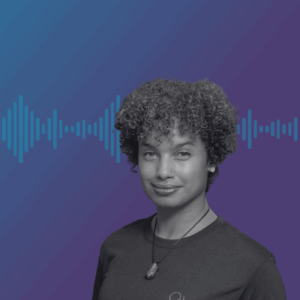
Transcript
Dominica McBride:
And the hope for culturally responsive evaluation was always social justice. It’s, how can evaluation make real change in the world?
Leon T. Andrews, Jr.:
Welcome to The Measure. I am your host, Leon Andrews, president and CEO of Equal Measure. At Equal Measure, we help foundations, nonprofits, and public entities advance social justice through learning, measurement, evaluation, strategy, and communications. On The Measure, you’ll hear conversations with leaders and practitioners about their social change work and how to support more equitable communities through centering racial equity and transforming systems.
Today, I am excited to be joined by Dr. Dominica McBride. She is the founder of Become, an organization focused on movement building and community transforming work.
Dominica McBride:
Thanks for having me.
Leon T. Andrews, Jr.:
I am so excited for our conversation and would like to get started first with more of a personal question. We usually start our conversations in that way at Equal Measure because, in doing this work, we believe in really understanding that personal context of understanding how we show up in the world, who we are, as we think about transforming systems. And I know context is central to the work at Become and in how you contextualize this in your new book, in Becoming Change Makers, as you talk about the journey of your grandfather in Haiti 1937.
I would love for you to share with our audience your background and how you think about context and culture and how that influences and continues to influence your life’s journey.
Dominica McBride:
I feel like I come from a line of warriors. I’m very proud of my cultural history and lineage. You mentioned my grandpa. He grew up in Haiti, and he grew up to lead the military of Haiti. And he was basically second to the president before Duvalier in Haiti. One of the things that he’s most proud of is leading the rescue mission of the Parsley Massacre. The president of the Dominican Republic basically put a hit on the Haitians who were on the side of the Dominican Republic on the border between Dominican Republic and Haiti. And they would ask the people who are on the border to say “parsley,” because that’s the only way they could distinguish who was Dominican and who was Haitian. And when they would say parsley the Haitian way, they would be killed. My grandpa led the rescue mission.
And when Duvalier was trying to come into power, he threatened my family. Eventually, that led to my family coming to the United States. My mom, her three sisters, my grandma were all part of the family, and eventually they came over to the United States. And my mom, my grandma and grandpa … And they ended up in Michigan, of all places. I was one of a handful of kids of color in this town and just experienced very different elements and aspects of people, of psychology, of community. In some ways, I was supported and welcomed and embraced and had really strong community around me. And in other ways, I experienced blatant racism and humiliation throughout my childhood. I became very passionate about creating strong, close-knit communities to heal the effects of discrimination, of racism, of prejudice, of the ills that we experience. That eventually led me to become a psychologist and start BECOME.
Leon T. Andrews, Jr.:
Thank you for taking a moment on reflecting on your journey and how that led you to BECOME and the BECOME Center. And in your book you also credit the late Dr. Stafford Hood, who is both a friend and mentor to both of us, has been over the years, who was the forerunner for the culturally responsive equitable evaluation, CREA, and for his mentorship toward you.
Dominica McBride:
I first met Stafford when I was applying to PhD programs. And I was going to Arizona State University for my interview for the doctorate program in counseling psychology. And he was one of the people that I wanted to focus on because I knew that he was doing work around evaluation. He was focused on justice. And I had read about his work before in doing culturally responsive education, in mathematics, culturally responsive assessment.
And I always remember that, after the interview, I was on the way back home. And I was in a hotel lobby. And I get this call. And I answer the phone, and it’s Stafford. And he tells me, “No matter where you choose to go, do what’s right for you. I’ll be here to support you. Do what’s right for you.” And that call alone just said so much about him, who he was, who his soul is, and that really paved the way to the principles and a lot of the building blocks of BECOME because he … one of the things he would say in teaching CRE is, “Go to the community, and just go to the local bar. Sit down, go to the local bar, and just talk to the people in there. Just go and be with the people and listen.”
Leon T. Andrews, Jr.:
I just enjoy listening to you as you talk about that journey that you’ve had and in your own journey and the shoulders we all stand on. A lot of this work that you also were naming is the commitment to what I think is so much, very much, tied the work, to your work, with BECOME and to the framework that you guys are … I don’t know if you call it a framework, but the culturally responsive community transformation that is tied to what you described in the book.
Dominica McBride:
Culturally responsive community transformation basically takes the principles of culturally responsive evaluation, which is community: community leadership, community voice; respect the culture, uplift the culture; and attend to the context. Understand the context, the sociopolitical context, and make changes in the context with the community. We are driven by those three principles in culturally responsive evaluation.
And the hope for culturally responsive evaluation was always social justice. It’s, how can evaluation make real change in the world? How does this data get back to the community so they can actually own it and make changes in their communities and in their conditions?
In taking these principles, we applied it to the neighborhood, not just working with an organization, but how do we create change and transformation in a neighborhood, where people are living in the same vicinity together? And they’re experiencing some of the same things because of the conditions around them. And they can work together. They have this kind of latent collective or potential collective power to tap into to truly transform things for thousands of people that are right there around them.
And in Chicago, we are a city of neighborhoods, and there are thousands of people in each neighborhood. That’s big. You can transform a neighborhood, you transform conditions for thousands of people. Culturally responsive community transformation is about listening to the community, and moving with the community, and innovating with the community, and creating new systems and structures with community, and community really driving it and using evaluation to do continuous quality improvement until the goals are met for the community.
And the book, Becoming Change Makers, is similar to this principle that Stafford talked about, that the community should own the data. The true client is the community in an evaluation. And it should come back to them. The findings. The data. They should own it. It should come back to them.
We did three different evaluations with three different groups at different times with the Chicago Foundation for Women, working on community-driven philanthropy, with Cultivate, which is a program, a leadership program for women of color advocates and organizers and public allies, which does leadership development for young people to go into nonprofit leadership, community leadership, toward social justice, but they wanted to know their impact on women in particular.
And when we did a meta analysis of those three projects, we saw themes cutting across those projects. They were uplifting some of these big lessons learned around the necessity of healing, the importance of relationships, the integrality of intersectionality, and the exploration of power and stepping into power. Those were the four big themes that came from it.
We have these 13 women who are part of these different programs who shared their stories around their lessons learned in these big four areas. These four thematic areas.
Leon T. Andrews, Jr.:
Given your background as a community psychologist, wondering if you could share, as you in your book talk about healing and wholeness, any examples, specific, concrete examples, maybe from one or two of the women that you’ve learned about collective healing. What does that look like? How can we pursue it?
Dominica McBride:
Michelle Morales. She leads the Woods Fund currently, and she has such a powerful story in her journey. During the pandemic, she learned that she had cancer, had breast cancer, and it forced her to have to take time away from work for her recovery, her physical healing, and recovery and treatment. And during that time when she was off of work—because work can be so consuming mentally, physically, emotionally, and sometimes we can lose ourselves in our work—she was forced to step away from work for that time.
And in that time, she started to really tap into her healing journey. Her emotional, spiritual, psychological healing journey. And she tapped into deep reflection, into journeying and healing with others like a coach. She saw things about herself that she hadn’t seen before. And all of these realizations started to feed into her own leadership and the way that she was with her team and the way that she was as a leader in her organization.
While that’s an individual path, it still taps into the collective. On her journey, she journeyed with another person that was also supporting her. And then her team was affected, and then her team grew with her. To be able to have that layered approach to growth helps in the healing journey. What I mean by layered approach to growth: it’s, when we grow, and we heal, others around us can also grow and heal in different ways. Because we end up being different with them. And when we’re different with them, they are also different with us, and then also can be different with others. Right? It’s this ripple effect that happens.
Leon T. Andrews, Jr.:
Yeah. I love that. Wonder if you wanted to share with our audience for you, all that’s been poured into you, what keeps you going? And what gives you hope?
Dominica McBride:
I talked about culturally responsive community transformation and how it’s related to listening to the community, as for the first phase of it. And we talked to 150 people in Auburn Gresham, which is a South Side community here in Chicago. And we talked to them about their hopes and dreams for their lives and their communities, their pain points in their lives, and what they see in community.
And the last question that we posed to them was, what is your wildest dream for yourself? A lot of people answered that by saying that they wanted to help their community. They would say, “I want to build a center for youth,” or, “I want to help people to overcome addiction,” or, “I want to see people care about each other.”
It was just amazing. The altruism. The altruism that people had and then the love that they had for other people and for their community. And that brings me so much hope. And that keeps me going in the work to support that and help that to come alive.
Leon T. Andrews, Jr.:
So grateful for this conversation, Dominica. Thank you for joining us today. It was such a pleasure talking with you. Thank you for taking the time to talk with me.
Dominica McBride:
Oh, my goodness. Such a pleasure talking with you, too, and I appreciate the time and the space and the connection.
Leon T. Andrews, Jr.:
Dominica, can you share more about where people can learn more about your book or if they wanted to download it?
Dominica McBride:
Yes. There is a book website called becomingchangemakers.com, and you can find the book on Amazon and bookshop.org. And if you’d like to learn more about BECOME, we’re at becomecenter.org.
Leon T. Andrews, Jr.:
I’d like to leave you with a quote inspired by my conversation with Dominica. It’s from the late Langston Hughes: “Hold fast to dreams. For if dreams die, life is a broken-winged bird that cannot fly.”
Thanks for listening to The Measure. Be sure to rate, comment, and subscribe to the podcast. Learn more about Equal Measure by visiting our website, equalmeasure.org. Until next time.